Agentic AI in Financial Services: Driving Autonomy and Efficiency in 2025
Agentic AI in Financial Services: Driving Autonomy and Efficiency in 2025 Home / Blog In the…

In the high-stakes world of financial services, executives juggle compliance demands, fraud threats, and the push for personalized client interactions—all while navigating talent gaps. Traditional artificial intelligence helps, but it often requires human prompts to shine. Agentic AI in financial services changes that, empowering AI agents to reason, decide, and act independently for proactive outcomes.
This shift is timely. A 2025 MIT survey shows 70% of banking leaders are deploying or piloting agentic systems. For senior leaders, it’s about unlocking efficiencies that traditional tools can’t match. Let’s break it down.
What is Agentic AI?
Agentic AI refers to autonomous systems that pursue goals without constant oversight, using reasoning to plan and execute multi-step tasks. In finance, these AI agents handle everything from fraud alerts to portfolio adjustments.
Unlike generative AI, which creates content on demand, agentic versions operate like virtual experts. They perceive environments, evaluate options, and adapt in real-time.
Agentic AI vs. Traditional AI
Traditional AI excels at pattern recognition, such as spotting anomalies in transactions. But it stops there, waiting for human input.
Agentic AI takes over: It investigates, resolves, and learns from the process. This autonomy suits finance’s dynamic nature, where delays cost dearly.
Why It Matters in Finance
Regulatory pressures and cyber threats are rising. Agentic AI addresses these by automating compliance checks and risk assessments.
For banks, it means faster decisions amid volatility. Forrester notes 70% expect it for tailored advice by 2025.
Core Components of Agentic AI Systems
Agentic setups rely on interconnected parts that mimic human workflows. These enable seamless integration with financial platforms.
Start with data inputs from APIs and databases. Then, the system processes and acts, looping back for refinement.
Reasoning and Planning
Reasoning engines evaluate scenarios using algorithms like decision trees. In finance, this plans responses to market shifts.
Planning breaks goals into steps, such as sequencing loan approvals. It’s crucial for complex agentic workflows in banking.
Tool Integration and Execution
Agents connect to tools like trading platforms or CRM systems. Execution handles actions, from blocking suspicious trades to sending alerts.
This integration ensures security, vital in regulated environments.
Learning and Adaptation
Feedback mechanisms use machine learning to improve. Over time, agents refine fraud models, reducing false positives by 20-30% in simulations.
Agentic AI Applications in Financial Services
Applications span the sector, from consumer banking to investments. McKinsey highlights its role in KYC and AML transformations.
Pilot programs show real impact. For instance, agents automate onboarding, cutting times dramatically.
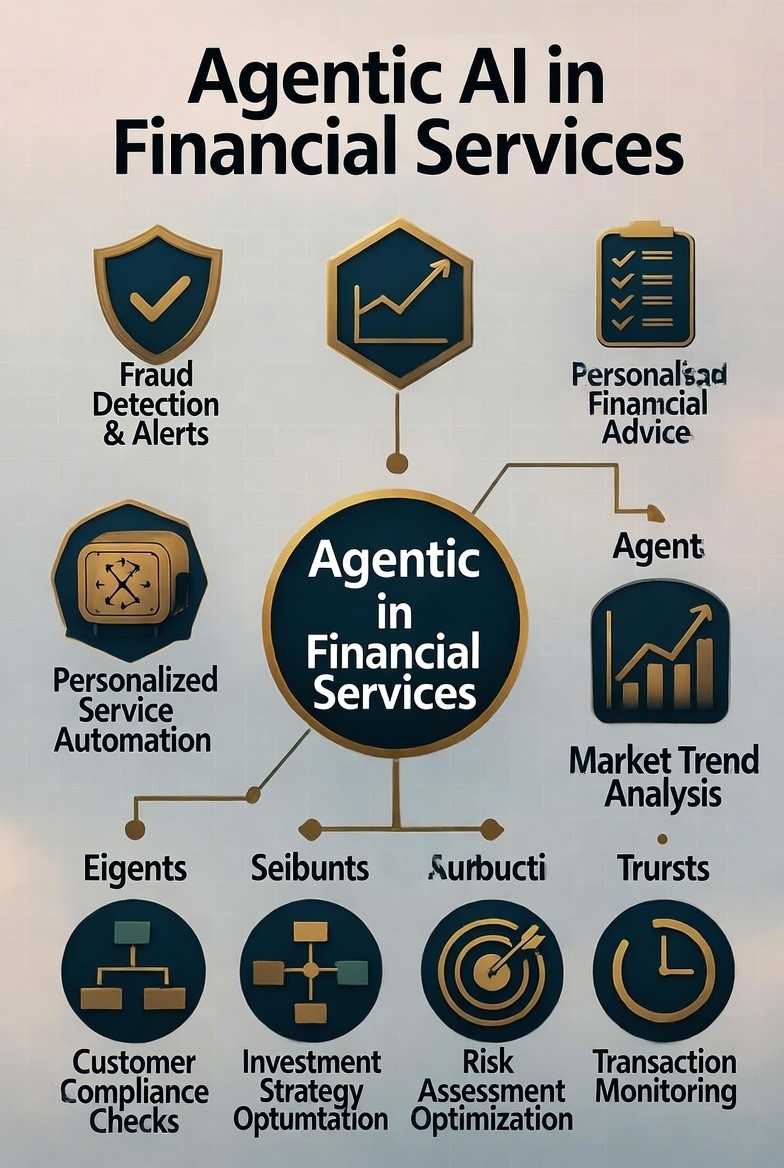
Fraud Detection and Prevention
AI agents monitor transactions in real-time, flagging and investigating anomalies autonomously. NVIDIA reports this closes detection-action gaps, minimizing losses.
In banking, they cross-reference data sources to prevent deepfakes, a growing threat per Citi.
Personalized Financial Advice
Agents analyze client data to offer tailored recommendations, like adjusting investments based on life events. This hyper-personalization boosts retention.
For small businesses, they identify credit needs instantly, as Salesforce examples show.
Risk Management and Compliance
In compliance, agents screen for adverse media and handle KYC refreshes. They ensure adherence to regs like GDPR.
Risk squads simulate scenarios, aiding capital allocation and reducing errors.
Automated Trading and Investments
Proactive AI in investments executes trades based on market trends. Adaptive systems adjust portfolios in real-time.
This democratizes access, offering affordable advice to underserved segments.
Benefits for Financial Institutions
Adoption yields tangible gains. BCG estimates 30-50% process acceleration with effective agents.
GenAI alone could add $157 billion to US banking in 2025. Agentic extends this further.
Operational Efficiency and Cost Savings
Automation cuts manual tasks, lowering costs by 20-40% in operations. Agents handle treasury workflows seamlessly.
This frees teams for strategic work, scaling without proportional hires.
Enhanced Client Experiences
Personalized interactions build trust. Agents adjust bill payments or guide homebuyers through financing.
Result: Higher satisfaction and loyalty in a competitive market.
[LINK: KrishuAI Financial AI Strategies]
Challenges and Ethical Considerations
Hurdles exist, like data biases and integration complexities. Moody’s warns of institutional challenges in automation.
Ethical deployment is key. Over-autonomy risks errors in high-stakes decisions.
Implementation Barriers
Legacy systems resist integration. High setup costs deter, though ROI hits 100%+ yearly.
Talent gaps in AI oversight add friction.
Risk Mitigation Strategies
Build guardrails for explainability. Use hybrid models with human validation.
Regular audits ensure fairness, aligning with 2025 regs.
Implementing Agentic AI in Your Organization
Start strategically. Assess high-impact areas like fraud or advice.
Platforms like AWS Bedrock offer building blocks. Partner for compliance-focused rollouts.
Step-by-Step Roadmap
This phased approach minimizes risks.
Key Tools and Partners
Anthropic’s Claude suits finance needs. Firms like Galytix specialize in agentic for banking.
[LINK: Explore KrishuAI Agentic Solutions]
Agentic AI in financial services is reshaping autonomy, from AI-driven fraud detection to proactive investments. With 2025 surveys showing rapid adoption, it’s essential for staying ahead. Contact KrishuAI to customize agentic strategies that deliver efficiency and growth for your institution.
Agentic AI in Financial Services: Driving Autonomy and Efficiency in 2025 Home / Blog In the…

Agentic AI in Hospitality: Elevating Guest Experiences and Operational Efficiency Home / Blog Running a hotel…

Industry Trends in AI: Key Shifts Shaping 2025 and Beyond Home / Blog Artificial intelligence is…