Agentic AI in Financial Services: Driving Autonomy and Efficiency in 2025
Agentic AI in Financial Services: Driving Autonomy and Efficiency in 2025 Home / Blog In the…

In today’s enterprise landscape, traditional artificial intelligence often falls short, bogged down by the need for human intervention in complex scenarios. Agentic AI Architecture addresses this by providing a robust framework for building autonomous AI workflows that reason, plan, and act independently. For senior leaders in financial services and hospitality, understanding this architecture is key to unlocking efficiencies that drive competitive edges.
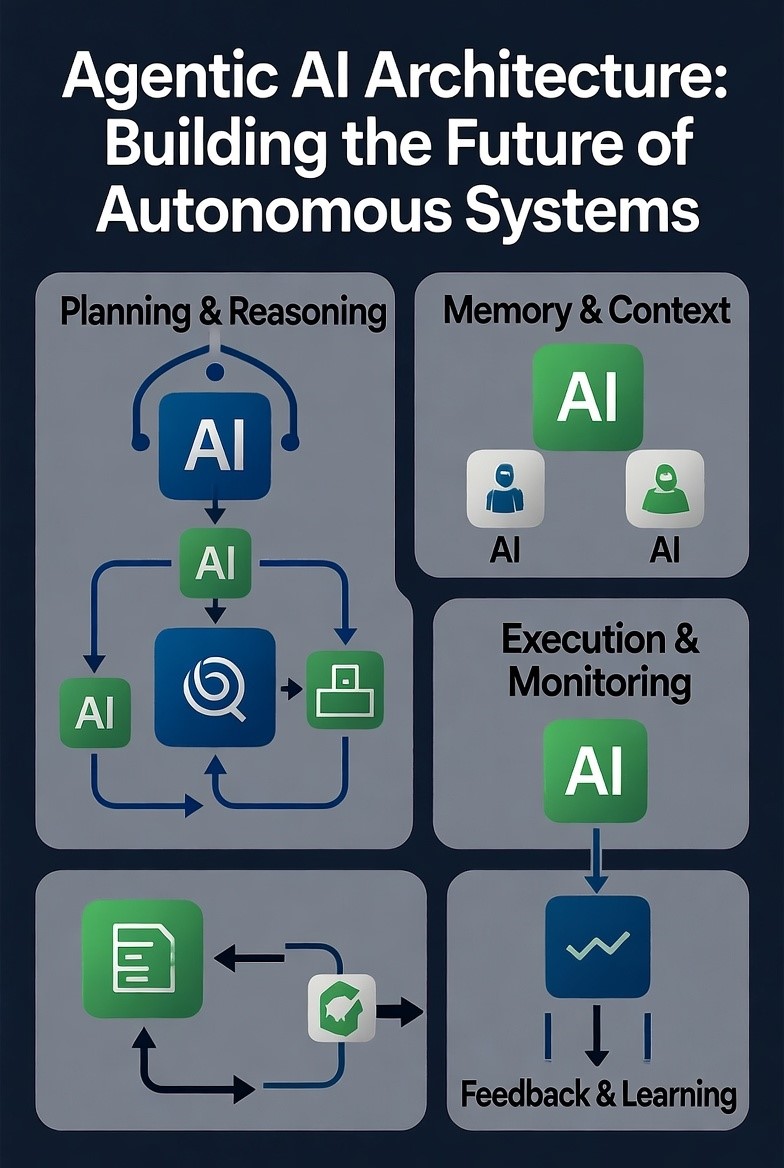
Agentic AI Architecture transforms passive large language models into goal-oriented agents capable of handling dynamic tasks. It’s not just about automation—it’s about creating systems that adapt in real-time. Let’s dive into its foundations and applications.
Agentic AI Architecture refers to the structural design enabling AI agents to operate with agency, pursuing objectives through perception, reasoning, and action loops. This setup allows for proactive decision-making in uncertain environments.
At its heart, the architecture integrates modular components that work in concert, much like a well-orchestrated team. For technical leaders, this means scalable systems that evolve with business needs.
Traditional AI relies on predefined rules or supervised learning, limiting it to narrow tasks. Agentic AI Architecture evolves this by incorporating autonomy, drawing from advancements in LLMs and reinforcement learning.
This shift, accelerated in 2025, enables AI to handle multi-step processes without constant reprogramming. Think of it as upgrading from a calculator to a strategist.
Modularity ensures components like planners and executors can be swapped or scaled. Scalability supports growing data volumes, while adaptability allows real-time adjustments.
These principles make Agentic AI frameworks resilient, ideal for high-stakes industries where downtime costs dearly.
The backbone of Agentic AI Architecture lies in its core elements, which form an event loop for continuous operation. These components interact to interpret goals, devise plans, and execute actions.
Understanding them technically helps in designing custom systems. For instance, integration with enterprise tools amplifies their power.
The goal interpreter breaks down high-level objectives into actionable steps, using natural language processing to align with user intent. Planning then sequences these steps, often via hierarchical task networks.
In practice, this component uses algorithms like A* search for optimal paths, ensuring efficiency in resource-constrained settings.
Execution involves the agent interfacing with external tools, such as APIs or databases, to perform actions. Tool use patterns allow seamless integration, like calling a trading API in finance.
This layer handles errors gracefully, retrying failed actions to maintain workflow integrity.
Memory stores short- and long-term data, enabling learning from past interactions. The evaluator provides feedback, refining future behaviors through reinforcement loops.
Technically, vector databases often power memory for fast retrieval, crucial for real-time applications.
Design patterns in Agentic AI Architecture provide reusable templates for common challenges. They guide how components assemble into effective systems.
Selecting the right pattern depends on task complexity. For leaders, this means tailoring to specific operational needs.
ReAct combines reasoning and acting in a loop, where the agent thinks aloud before executing. Reflection allows self-critique, improving accuracy over iterations.
These patterns shine in debugging scenarios, reducing errors by 20-30% in simulations.
Multi-agent systems distribute tasks across specialized agents, orchestrated for collaboration. Communication protocols ensure synchronization.
This pattern scales for enterprise, handling parallel processes like risk assessment teams.
Planning patterns decompose goals into sub-tasks, while orchestration manages workflows dynamically. Tools like finite state machines guide transitions.
In 2025, hybrid planning with LLMs enhances foresight, predicting outcomes with higher precision.
Bringing Agentic AI Architecture to life requires aligning it with business processes. Start with pilot projects to test integration.
Platforms like AWS or custom frameworks facilitate this, offering pre-built components.
In finance, Agentic AI Architecture powers autonomous trading systems. A planner interprets market goals, an executor places trades via APIs, and feedback loops adjust for volatility.
For example, fraud detection agents collaborate in multi-agent setups, reducing false positives by analyzing patterns in real-time. This can yield 40% faster response times.
[LINK: KrishuAI Financial AI Architectures]
Hospitality leverages autonomous AI workflows for operations. An agentic system might plan room allocations based on guest data, execute bookings, and refine via feedback from occupancy sensors.
Multi-agent designs handle front-desk queries and maintenance, boosting guest satisfaction scores by 25% in case studies. It’s about creating seamless experiences without manual oversight.
Adopting Agentic AI Architecture delivers quantifiable gains. Enterprises report 30-50% productivity boosts through automated decision-making.
The technical robustness ensures reliability, turning AI into a strategic asset.
Streamlined workflows cut operational costs, with agentic systems handling tasks 5x faster than humans in repetitive scenarios. Scalability means handling spikes without added infrastructure.
ROI often exceeds 100% within a year, driven by reduced errors and faster iterations.
Beyond efficiency, it fosters innovation. Leaders gain data-driven insights from agent reflections, informing long-term strategies.
In competitive fields, this architecture provides agility, adapting to market shifts proactively.
Despite advantages, challenges like integration complexity arise. Overly autonomous systems risk misaligned actions if not governed properly.
Addressing these technically ensures safe deployment. Focus on hybrid human-AI oversight.
Data biases in memory components can skew decisions. Scalability issues emerge without proper orchestration, leading to bottlenecks.
Security vulnerabilities in tool interfaces demand attention, especially in regulated industries.
Implement explainable AI for transparency. Use agentic AI best practices like modular testing and phased rollouts.
Regular audits and ethical frameworks mitigate risks, ensuring compliance with standards like GDPR.
In wrapping up, Agentic AI Architecture stands as the technical foundation for next-gen artificial intelligence, empowering autonomous AI workflows that redefine enterprise operations. By mastering its components and patterns, leaders can achieve unprecedented scalability and insight. Reach out to KrishuAI for expert guidance on architecting your custom solution—let’s build the future together.
Agentic AI in Financial Services: Driving Autonomy and Efficiency in 2025 Home / Blog In the…

Agentic AI in Hospitality: Elevating Guest Experiences and Operational Efficiency Home / Blog Running a hotel…

Industry Trends in AI: Key Shifts Shaping 2025 and Beyond Home / Blog Artificial intelligence is…